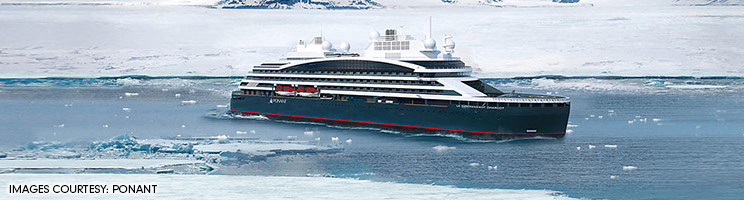
After being fitted out in the Norwegian shipyard of the Vard company in Søviknes, Le Commandant-Charcot arrived in Saint-Nazaire, to be placed in the Joubert dry dock. The work to fit the propulsion systems has been entrusted to the naval department of Eiffage Énergie Systèmes-Clemessy Services. The two Azipod ABB (Azimuthing electric podded drive) propulsors, which had been delivered in advance to the shipyard, are the electric motors driving five propeller blades, with the entire structure able to pivot 360°. They provide propulsion in all directions thus offering great maneuverability, particularly in the extreme polar regions where the ship will sail.
In parallel with this fitting work, the ship’s hull will also be painted. Le Commandant-Charcot will then return to the Søviknes shipyard, where the fitting out will be completed, before delivery scheduled for 2021.
Equipped with 135 staterooms, Le Commandant-Charcot will be the first polar exploration vessel operating on a hybrid electric LNG system. This major innovation is testimony to the company’s solid commitment to sustainable tourism with a minimal environmental impact.
Participation in scientific research on the polar regions
Ponant has decided to make Le Commandant-Charcot available to the scientific community. As a “ship of opportunity,” it will be fitted out with infrastructure (laboratories, staterooms) and materials at the disposal of scientists. In this way it will offer a unique platform for observation, research and analysis of the water, air, ice and biodiversity in these extreme polar regions.
Sustainable commitment and environmentally friendly protocols
With Le Commandant-Charcot, Ponant continues to consolidate its polar expertise, drawing on 20 years of experience, and remaining loyal to its philosophy. It will allow the company to maintain reasoned activity, in compliance with its commitments to the IAATO, AECO and Cercle Polaire associations, with unique landing protocols and itineraries to preserved sites that are only accessible to limited capacity vessels.