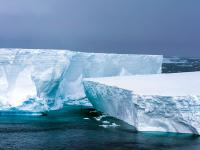
One word best describes the Weddell Sea and Antarctic Sound: immense. That applies equally to the ice formations, penguin colonies, and vast stretches of sea. In Antarctic Sound and the Weddell Sea, we will encounter massive tabular icebergs. These bergs don't calve from tidewater glaciers but from ice shelves-and many will dwarf Ocean Explorer. Some in the Weddell Sea reach the size of a football field or larger. Their smooth, tabletop-flat surfaces reflect the ocean beneath: flat seas yield flat ice. Ice shelves stretch from land into the sea. In the northwest corner of the Weddell Sea, penguin colonies can number in the tens of thousands. For travelers seeking Adelie penguins, Antarctic Sound and the Weddell Sea offer prime viewing of this iconic species-the most southerly breeding penguin, and possibly bird, on Earth (though snow petrels, prevalent here, are also a contender for that crown). Gentoo penguins are found here too, and you'll have chances to spot chinstraps. The legendary Snow Hill emperor colony lies in this region; while we won't reach it, we may encounter individual members on the ice. The Weddell Sea is less visited than the Gerlache Strait, not for lack of beauty, but due to its ever-shifting ice. On this voyage, we've added an extra day in this area-time enough for a true adventure into this endless wilderness, and to ensure we can fully embrace the dance with the ice. In the Weddell Sea, penguins are our priority-but ice will guide our course. Alongside towering tabular icebergs, we'll likely encounter vast stretches of sea ice, more than on the Peninsula's west side. Your Expedition Team and bridge officers will track charts and forecasts, seeking openings to navigate toward the region's highlights, and intentionally visiting the ice edge to maximize our time in this remarkable environment. Our route will be shaped by sea ice and weather, but every destination-whichever we visit first or last-will be exceptional, evoking words like profound, humbling, and surreal. We'll make every effort to visit large Adelie penguin colonies-at Brown Bluff, Paulet Island, or Tay Head-ranging from 20,000 to several hundred thousand penguins, including gentoo. Photos and documentaries can't match the experience of standing before tens of thousands of penguins. The sounds alone-partners calling, chicks crying for parents, wind and waves against the shore, and the distant crack of calving glaciers-create an acoustic landscape of pure wildness. Add the sight of a penguin-covered landscape, and you have an encounter that's impossible to replicate. The currents of Antarctic and Active sounds are mesmerizing. While you're in a Zodiac, you may observe ice-large and small-flowing through narrow straits at several kilometers per hour, a raw display of the power of water. From shore, you may glimpse or sense the ice's movement. Your Zodiac may pass through open water, while your return ride could weave among drifting floes, crackling brash, and scattered bergy bits. The Weddell Sea is known for superb birdwatching-especially Cape, snow, and southern giant petrels-and the chance to spot Weddell, crabeater, or leopard seals onshore or catching rides on the drifting ice. Sightings may occur near Adelie colonies or at sites like Kinnes Cove and Active Sound. When ice opens in the Weddell Sea's northwest, whales follow-lured by the feeding opportunities. Humpbacks and minkes are most common, with occasional killer whales. Conditions may also allow us to explore areas frequented by fin whales, and possibly southern rights. For historians, the Weddell Sea brims with stories-from Shackleton's legendary Endurance survival and Nordenskjold's gallows-humored ordeal on Antarctic to far older histories told by the 60-million-year-old fossils on The Naze, and Vega and Cockburn islands. Fossils are discovered here partly because large areas remain relatively snow-free. Volcanic activity has painted these sites-as well as Brown Bluff on the Peninsula's mainland-in rich reds, burnt oranges, and chocolate browns. In a landscape dominated by white, gray, and blue, these colors add a vivid layer to a region steeped in both human and ancient geological history. This itinerary offers the best of a polar expedition-soak in the vastness of the Weddell Sea and Antarctic Sound from your ship, then get up close to stunning geological formations by Zodiac or kayak. ...
Read More


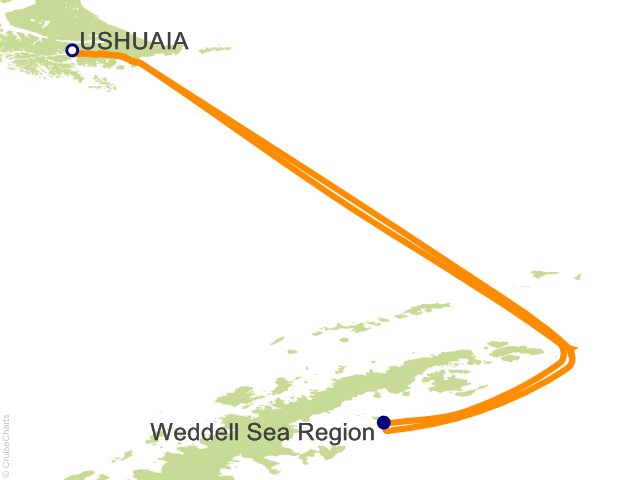

 Track this Cruise.
  Favorite this Cruise and receive Price Alerts when the rates go up or down.