 Messina, Italy
By Alara Shannon, Marketing | February 01, 2013 ( Comments)
Messina, Italy
Messina, Italy is a bustling port town and the third largest city on the island of Sicily. Sicily itself is the largest island in the Mediterranean at 150 miles wide and 200 miles long, but with a population of over 5 million it is also one of the most densely populated.
Situated off the toe of the Italian ‘boot,’ Messina is separated from mainland Italy by only three miles and the Strait of Messina. The ‘door of Sicily’ is the closest city to the mainland and a popular port of call for travelers from other areas of Europe.
Founded by Greek colonists in the 8th Century BC, Messina has a long and complex history rooted in Greek mythology with influences from Roman, Byzantine and Roman rule. The city has also endured other tragic disasters: a revolt against the Spanish in 1678, which burnt the city to the ground; earthquakes in 1783 and 1908 (the latter sank the shore half a meter and killed over 60,000 people); and World War II bombing in 1943. Despite all of the adversity, the resilient townsfolk diligently rebuilt the city and it remains a crowded port city.
This history of disaster and the fact that the majority of the city has been rebuilt within the last 100 years results in a unique blend of new architecture with old styles.
Sicily’s economy is supported mainly agriculturally with citrus fruits, wine, olives, vegetables and grapes the main crops. Fishing is still an important industry, accounting for 25% of Italy’s annual seafood.
Messina has a Mediterranean climate with dry hot summers and mild winters. The currency in Messina is the euro; some shopping boutiques will accept credit cards with a low exchange rate. Tips are included; otherwise the average tip in Italy is 10%. Locally they are accustomed to bargaining.
The language in Messina is Italian and English is not commonly spoken outside of the main tourist hubs.
Useful Italian phrases:
- Yes - Si
- No - No
- Good day - Buon Giorno
- Good bye - Ciao
- Thank you - Grazie
- You're welcome - Prego
Where You'll Dock in Messina, Italy
Cruise ships dock right in downtown Messina. The heart of old town, Piazza del Duomo, is easily reached by foot. If heading further into Sicily, taxis are readily available at the pier but make sure to negotiate a fare prior to departure. Some drivers may accept US dollars.
There is a train station located just 1 mile from the pier that will take you to Taormina, a beautiful nearby coastal down, but at Taormina is at the bottom of very large hill and it will be necessary to take a bus or taxi to reach Taormina.
What to Do in Messina, Italy
1. Near the cruise ship dock is Piazza del Duomo which houses the Cathedral of Messina. This Cathedral, a fine example of 11th century Sicilian Norman architecture, retained its roots once reconstructed after the 1908 earthquake and damage during the War. Its Bell Tower holds one of the world’s largest astronomical clocks, Orologio Astronomico, a remarkable Messina experience. Right before noon, at 11:55am, the clock mechanically animates statues, which illustrate events from the civil and religious history of the city. A lion roars, a bird flaps its wings, and two historical heroines take turns ringing the bell, all before it ends with a statue of Jesus appearing from a tomb.
2. Church of the Annunziata dei Catalani (late 12th-13th century) is an original Crusader’s church just two streets east of the Cathedral of Messina. Dating from the late Norman period, it was transformed in the 13th century when the nave was shortened and the façade added. It clearly reflects Arabic architectural influences.
3. The “Museo Regionale” (Regional Museum) is the main art museum in Messina and one of the city’s top sights. Just under two miles from the pier, this museum features renaissance painting, sculptures, architectural fragments and many works from churches or other building damaged or destroyed in 1908. Among the earliest works are icons and crucifixes from the 13th – 15th BC. Small admission fee.
4. Other Messina landmarks include: The Fountain of Orion, located next to the Cathedral, built by Giovanni Angelo Montorsoli in 1547; The Botanical Garden “Pietro Castelli” of the University of Messina; Porta Grazia, 16th century gate still standing as a fortress in the harbor; and Santa Maria degli Alemanni (early 13th century), which was formerly a chapel of Teutonic Knights. Along the way you will find shopping boutiques of every type, restaurants, cafés, local vendors selling hand painted artwork, local musicians and fresh produce.
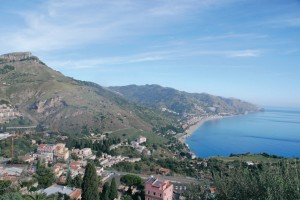
5. One of the most popular attractions is located 35 miles outside of Messina. Taormina was founded in 358BC, and is a wonderfully preserved town with a medieval atmosphere despite its Greek and Roman past. Today, this pretty coastal town is perched on high cliffs overlooking the sea with great views and excellent shopping. Thus, making it a popular resort destination, rivaling other Mediterranean beauties like Italy’s Amalfi Coast.
Our own Alexis Wargo took a shore excursion to Taormina on her Royal Caribbean Mediteranean cruise.
Her thoughts:
On our tour to Taormina we took a 40- 45 min motor coach along coast line and mountainous highway, about 35 miles from Messina. Walking Tour was on cobblestone in the famous Corso Umberto, Taormina’s main street. A scooter could travel along the street, but there are many steps if anyone wants to take an avenue off Corso Umberto. No traffic allowed inside city walls, therefore all touring must be done on foot and travelers must be able to walk uphill for .25 mile to get to village gates of Taormina from taxi, motor coach or train stops. Wear very comfortable shoes and casual attire.
Shopping included: sicilian Italian pastries like my Cannoli and café con leche, local wines from the fertile ground of Mt Etna, olive oil and pasta of every shape size and color, fine Italian leather, handcrafted ceramics, unique jewelry, fragrances, handmade towels & bed spreads and every flavor of Gelato imaginable.
Visited: Corso Umberto, main Walkway through Taormina; Nicola Cathedral, largest church in Taormina built in 1400; Piazza Aprile, panoramic view from Taormina square; and Porta Messina, ancient city gate.
Don’t miss: the Greek Theater located at very end of Taormina, built for music in 3rd century BC & still used today!
6. Another popular destination is Mount Etna, one of the most active volcanoes in the world and is in an almost constant state of activity. It is also the tallest volcano in Europe, dominating the eastern coast at a height of 10,902 feet. To the ancient Greeks, Mount Etna was the realm of Vulcan, god of fire, and the home of the one-eyed monster known as the Cyclops.
Alexis says: Surrounded by the largest wilderness area in Sicily, Parco dell’Etna, Mount Etna erupts every year. Tours are offered by most cruise lines, or you can hire a car and travel independently.
Taxis will take you but will not be cheap. The local bus and train services are slow and unreliable for meeting sailing times. Where famous active Volcano Mt Etna is located- buy a lava stone, a beautiful panoramic view, local vineyards, orchards and possible wine tasting.
7. Fans of “The Godfather” will not want to miss the town of Savoca, a hill town north of Taormina. This is where you’ll find Bar Vitelli and the church where Michael was married. Visitors will also find picturesque old churches, spectacular views of the surrounding hills and the Ionian sea, and the Capuchin monastery where the mummified bodies of prestigious city residents from 2 centuries ago are on display.
You can visit Messina (Sicily), Italy on many Mediterranean cruise itineraries.


